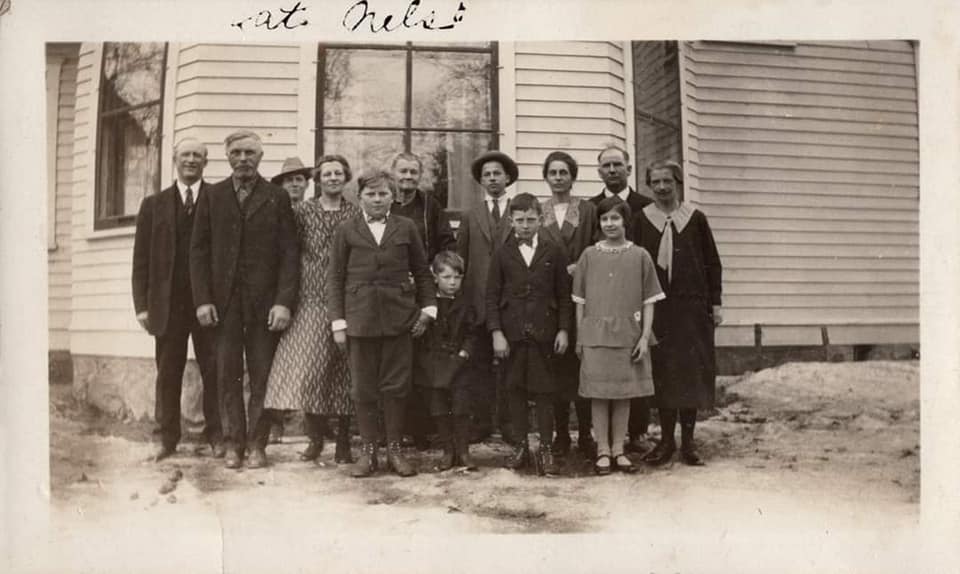


The first image is a photograph, from my great-grandmother’s photo album, taken in 1926 at Nels and Anna Anderson’s farm, located in section 14 of Bertha township, one mile southeast of Bertha, Minnesota. My great-grandaunt Anna (fourth from the left) was the second of five children, born to Carl and Mathilda Swenson on April 29, 1873 at Kummelby Frälsegård in Hogstad, Mjölby, Östergötland, Sweden. She was ten years old when she and the family emigrated to America, departing from Gothenburg on July 13, 1883. They arrived in Boston on July 30, 1883 and first made their way to Chicago. After living four years in Carver, Minnesota, they moved to Fergus Falls for one year before finally settling in Bertha township on October 9, 1888.
My great-great-grandfather, Carl Swenson, purchased 160 acres in section 16 of Bertha township from the Great Northern Railway Company in 1888. Anna helped her father build “a board shanty to live in for the summer” and then “rolled up a one room log house.” Carl, his three brothers, and his son Charlie were all carpenters, cabinet and furniture makers so it would not have been long before improvements were made. The neighbors to the west were William Bluhm and Charles Bottemiller. The 80 acres of land originally owned by John and Bertha Ristau was adjoined on the north side. The second image is a picture of Bertha, namesake of the township and village in Todd county.
Bertha and her husband arrived in November 1876 and settled in section 9. They were the first settlers in the area. My Dad and I drove past the historical marker on our trip last summer. It reads, “On this corner in 1876 the first white woman Bertha Ristau and her husband built a log cabin which served as the first store and post office in this area …” I thought it was interesting so I took a photo and pinpointed the GPS coordinates. The third image is the photo I took of the marker.
Later, I consulted the old sectional map of Todd county published in 1890, the History of Todd County written by Clara Fuller in 1915, and other historical records including my great-grandmother’s notebook. That’s when I discovered the marker was placed at the wrong location! It should have been placed 2 miles northwest, in section 9, at the corner of County road 1 & 430th street instead of its present location in section 16 at the corner of Highway 71 and 420th street.
When Bertha and her husband had arrived, other families soon followed. The Bottemillers also moved there in November 1876 and the Bluhms were one of about fifteen families that settled later. They had come from southern Minnesota, and as the story goes, Wilhelm Bluhm was chased from his fields by a cloud of grasshoppers. When he returned the next day, he found that they had eaten his jacket, all but the buttons, along with his entire crop. So he came north, purchased land near the river, fetched his wife and their children – William, Henry, and Sophia – and started a farm.
On June 12, 1873, farmers in southwestern Minnesota saw what looked like a storm coming from the west. It wasn’t until they heard the loud roar of beating wings that they realized it was grasshoppers. In a matter of hours, knee-high fields of wheat were devoured by grasshoppers. For four consecutive years, the grasshoppers ravaged parts of southern Minnesota. So between 1876 and 1877, emigrants from the southern region settled in Bertha township to escape the plague which in some places darkened the skies. Hordes of grasshoppers would descend and within just a few hours, all wheat, oat, corn, and barley crops were destroyed.
Many who settled in Bertha were of German descent. They came by covered wagons drawn by oxen. Their footwear consisted mostly of socks filled with hay to keep their feet warm. They cut hay with crude scythes. These early pioneers were undaunted by the severe hardships. Some arrived in the winter and used their covered wagons as shelters until cabins could be built. Timber was cut, fields were cleared, and crops planted into the rich, fertile ground.
Among the other families that settled in Bertha township were David Steinbach and his brother Louis, Adam and Mina Munch with their sons George and Peter, Jonah and Alma Signor with their son Nelson, James and Loretta Bonar with their daughter Dema, August and Christina Tarnow with their daughter Malvina, Samuel and Mary Sahli, Julius Klebs, and Jacob Kohlhase. They were mostly German Methodists. A German Methodist Episcopal church and parsonage was eventually built across from the Carl Swenson farm. George Munch married my great-great-grandaunt, Charity Maynard, in 1884. Dema Bonar later married my cousin, Marion Francis Maynard, in 1888. Jonah Signor sold his land to my great-great-grandfather, John Hokanson, in 1890. Malvina Tarnow married my great-granduncle, Charlie Swenson, in 1903.
My great-great-grandparents, Marion and Oma Crider, had arrived in 1879. They owned 80 acres in section 26 of Bertha township in addition to 120 acres in section 6 of Eagle Valley township. My great-great-granduncle Robert Maynard owned 40 acres in section 36. In 1880, John Ristau established the post office inside his log cabin store which saved the pioneers long walks to Verndale to get their mail. In addition to operating his store, he became the first postmaster and town clerk. The post office was located across the road from the Carl Swenson farm. The fourth image is a picture of the cabin that served as the first home, post office, and store in Bertha.
In 1884, the Great Northern railroad was built to nearby Eagle Bend. Charles Bottemiller married Sophia Bluhm later that same year. Before long, other pioneers like the Westergren, Swenson, and Hokanson families had settled in Bertha township. Newcomers called this area “the Big Woods.” As my great-grandmother wrote in her notebook, it was “all big woods then” with “a lot of maple and oak, elm, ash, basswood, and ironwood.” Charles Bottemiller and the Bluhm brothers established a sawmill, doing business as Bottemiller, Bluhm & Co. They produced about 18,000 feet of lumber per day. The mills and creameries were the lifeblood of the Bertha community, once known as “Dairyland USA.”
Early pioneers settled along the river because meadows there would provide hay and pasture, with water to run the mills. Then they settled down to cut the hardwoods and pine, to grub out the stumps and plant corn. In 1890, Anna, at 18 years of age, returned to Fergus Falls and was employed there by her uncle, Andrew Swenson, for four years at his hotel. The railroad was extended north from Eagle Bend to Bertha in 1891. With the coming of the railroad, the village of Bertha developed and three blocks were platted on August 25, 1891, by Francis and Louis Riggs. The land was rapidly taken and settled by permanent residents and a rural community was established. They worked, worshipped, helped start country schools, and organized the township and village of Bertha. Magnus Westergren and my great-great-granduncle, Mark Maynard, were elected to local government in 1897.
In Fergus Falls, Anna Swenson met her future husband, Nels Anderson (pictured in the first image, second from the left). He had started his journey from Sweden to America at the age of 18. Upon his arrival in 1883, he was employed on farms, worked on railroads, and did construction work for several years. While working on a construction job in Fergus Falls, he met Anna. They were married on March 6, 1895 and purchased the 80 acre farm in section 9 that formerly belonged to Bertha Ristau. By 1900, they had sold the farm to Reinhardt Paschke and moved after purchasing 200 acres of land in section 14, next to the John Hokanson farm.
The farm Anna and Nels Anderson developed was described by the newspaper as “one of the finest homesteads in Todd county.” They lived on the farm until the death of Anna on June 5, 1933. Three months after celebrating their 38th wedding anniversary, she suffered a stroke. On the morning of Sunday, June 4, Anna and Nels had attended services in the Bertha Congregational church. In the afternoon, they entertained friends and relatives. After supper, Anna assisted with the farm work but fell ill after milking a few cows. Nels carried her to the house and a doctor was called. Her right side and arm were affected by paralysis but she made light of the situation and said she would just be forced to begin to write with her left hand so she could continue to correspond with her eldest son Herbert who lived in Crookston, and her youngest son Elwyn who lived in Minneapolis. Her condition became increasingly serious and at about 11 o’clock, she suffered a cerebral hemorrage, lost consciousness, and passed away the following day.
In the wake of her death, Nels sold the farm and moved to Minneapolis to live with his son. In June 1956, my great-grandmother wrote in her notebook that Wallner owns the 200 acre farm in section 14. Frank and Catherine Wallner purchased it when they moved to Bertha in 1945. According to property records, their grandson, Peter Wallner, owns it today. The 80 acres originally owned by John and Bertha Ristau and purchased by Nels and Anna Anderson was sold to Milford Ashbaugh in 1950. Milford and his wife Bernice lived on the farm until 1977. (Clara wrote that their daughter Betty Ashbaugh married Darrel Kapphahn who was the grandson of my great-grandmother’s close friend Edith Kapphahn. They lived next door to each other in the apartments above the Golden Rule store, owned by Leonard Bluhm, grandson of Wilhelm Bluhm.) Today, the 80 acre farm in section 9 is owned by Milford’s son, Lyle Ashbaugh.
Everyone in the first image is a first or second-generation immigrant from Sweden. (Not pictured: Richard Westergren, who may have been the one taking the picture.) Rodney lived in Bertha for nearly 80 years before he passed away on March 18, 2000. All but one are buried at Zion cemetery.
From left to right:
● Frans Westergren (great-granduncle)
● Nels Anderson (great-granduncle)
● Arthur Hokanson (granduncle)
● Anna Swenson-Anderson (great-grandaunt)
● Elmer Westergren (1st cousin twice removed)
● Mathilda Hokanson (great-great-grandmother)
● Rodney Westergren (1st cousin twice removed)
● Ralph Hokanson (grandfather)
● Stanley Westergren (1st cousin twice removed)
● Clara Swenson-Hokanson (great-grandmother)
● Dorothy Hokanson (grandaunt)
● Herman Hokanson (great-grandfather)
● Hilda Swenson-Westergren (great-grandaunt)
