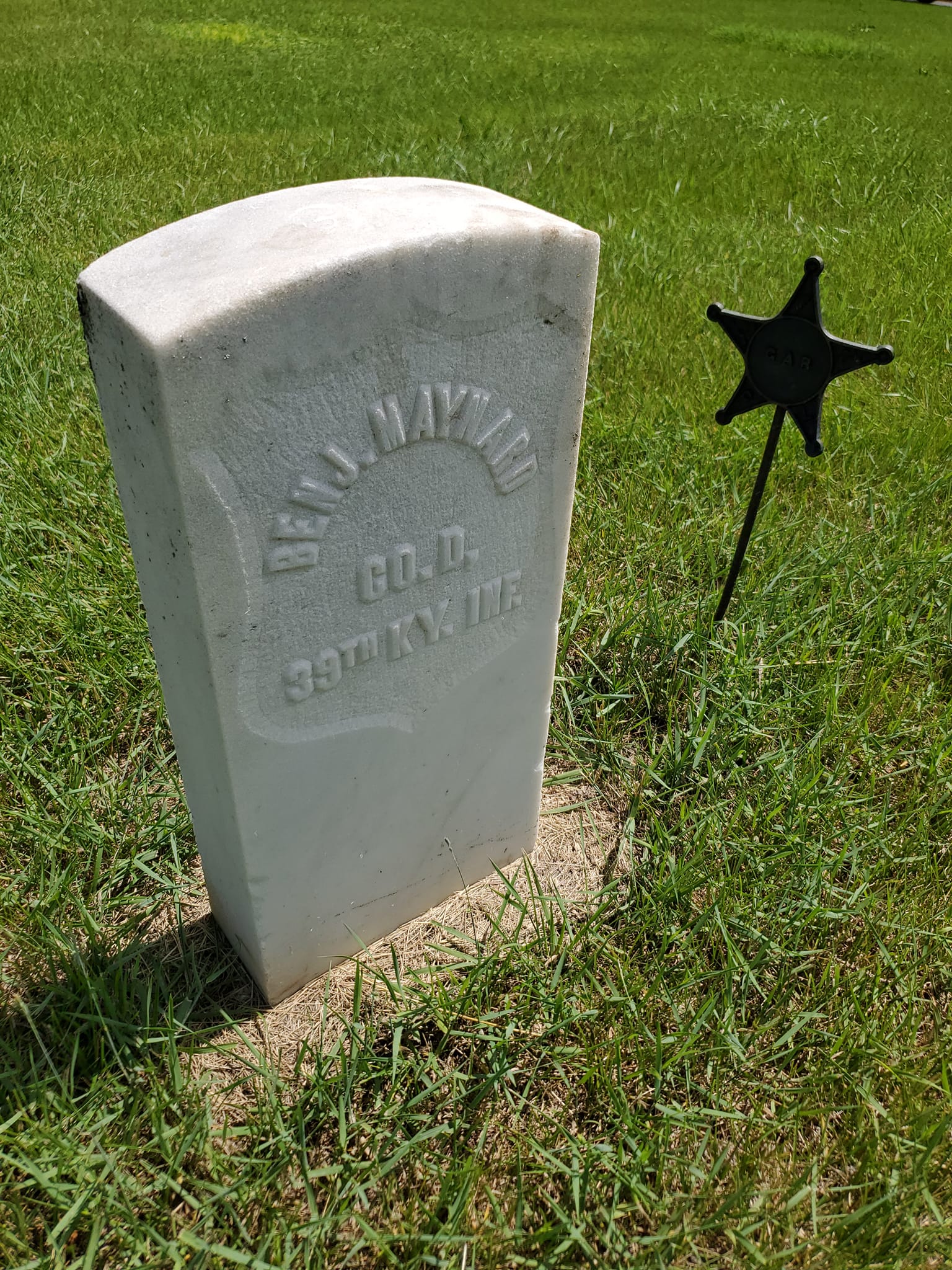
My Dad and I visited 𝗘𝘃𝗲𝗿𝗴𝗿𝗲𝗲𝗻 𝗖𝗲𝗺𝗲𝘁𝗲𝗿𝘆 where more than twenty cousins from my paternal grandmother’s side are buried. There was a directory and map at the entrance which made it easy for us to find their graves.


𝗕𝗲𝗻𝗷𝗮𝗺𝗶𝗻 𝗠𝗮𝘆𝗻𝗮𝗿𝗱 was a Civil War veteran who fought for the North. He enlisted in the Union Army on September 10, 1862 and served as a corporal in the 39th Kentucky Infantry. His son, Amos Maynard, and son-in-law, Alexander Runyon, also served in the same regiment. In the aftermath of the Civil War, my great-great-great-grandfather, Reverend William Maynard and his cousin Benjamin moved their families from Kentucky for Minnesota. They were among the earliest pioneers of Todd county, Minnesota.
A book by Clara Kingsley Fuller, published in 1915, titled 𝘏𝘪𝘴𝘵𝘰𝘳𝘺 𝘰𝘧 𝘔𝘰𝘳𝘳𝘪𝘴𝘰𝘯 𝘢𝘯𝘥 𝘛𝘰𝘥𝘥 𝘊𝘰𝘶𝘯𝘵𝘪𝘦𝘴, 𝘔𝘪𝘯𝘯𝘦𝘴𝘰𝘵𝘢 offers the following insight on page 225: “In July 1866, Benjamin Maynard came on foot from Elk river, the end of the railroad at that time, and filed on land up the river beyond Whiteville and built a cabin to be occupied by his family later in the season. Maynard was a soldier in the Union army and being a native of Kentucky, he concluded that he could not live among his old neighbors, most of whom were in sympathy with the Southern cause.”
Benjamin worked to secure the funds necessary to bring the rest of his family to Minnesota. After his wife, Elizabeth “Betsy” (Deskins) Maynard, and eleven of their children (including Esther, William Harmon, Mary Anna, George W., Harrison Christopher, Benjamin Garrett, Sarah, Lewis, Marion, and James) arrived in St. Paul, the family traveled overland by covered wagon to St. Cloud. They eventually settled in Todd county. Ten years before Todd county had been established, Long Prairie became the site for the Indian agency. However, there were but few remains of the Indian agency when they arrived.
Their first night spent in Todd county was at the site of the present courthouse. At that time, there were no buildings or houses in Long Prairie. They established their farm on the frontier, along the Long Prairie river, near Clotho, and lived as pioneers in the wilderness. Benjamin and his sons worked extremely hard to clear the land for the farm that became one of the largest in the early days.
Esther Maynard married Alexander Runyon on October 11, 1866. For the next three years, other “newcomers poured into that section and took up land mostly along the river, as far up as the western border of the county.” Among these first settlers were William McGuire, James Davis and others from Kentucky, along with Almon M. Doty, William Beach, and John B. Leslie. Mary Anna Maynard married A.M. Doty on April 13, 1869.
“At the end of the Civil War, the communities west of Long Prairie were settled by soldiers who had fought for the Union Army that were not very welcome in their home state of Kentucky. Once located at the present intersection of County Roads 38 and 11, Whiteville was settled by the three White sisters and their families. Clotho, it seems was settled where it is because settlers couldn’t go any further. The forests and swamps to the west were impenetrable.” According to a reference book, published in 1920, titled 𝘔𝘪𝘯𝘯𝘦𝘴𝘰𝘵𝘢 𝘎𝘦𝘰𝘨𝘳𝘢𝘱𝘩𝘪𝘤 𝘕𝘢𝘮𝘦𝘴, “Whiteville was the name commonly given to an early settlement in 1865-6, about five miles west of Long Prairie.” It was named after three sisters, “whose maiden name was White.”
William McGuire was an old friend and neighbor of Benjamin Maynard who had been “known throughout Pikeville as ‘Uncle Billy’.” He and Benjamin served in the same unit during the Civil War. Corporal McGuire was captured by Confederates at “Wireman’s Shoals on the evening of December 4, 1862” and confined “in a rail pen that night on John’s Creek” before being transferred to a prison camp in Richmond, Virginia. However, he regained his freedom after a prisoner exchange on May 19, 1863. “At the Battle of Mount Sterling, he was thrown over the top of his horse, sustaining injuries to his legs and lower back.” Benjamin was there while he was carried off the battlefield.
In 1866, William fled Pikeville with his wife and children, fearing for their safety after the war. The family made its way to Todd county. McGuire’s homestead was adjacent to that of Benjamin Maynard. He raised his family there along with several other Kentucky veterans” who later joined them. William Beach came to Todd county with his family in 1869 or 1870 and settled at Clotho, shortly before a sixteenth child was born to Benjamin and Betsy Maynard.
Their second-born son, Amos Maynard, filed his claim with the General Land Office in St. Cloud on August 23, 1872 and established a homestead on forty acres in the southeast quarter of the northeast quarter of section six in Reynolds township. Reynolds had been established in 1871 and named in honor of a Civil War general whom several Todd county settlers had served. On September 25, 1872, Benjamin Maynard filed his claim for a homestead on one hundred sixty acres in the east half of the northwest quarter and the east half of the southwest quarter of section six in Reynolds township. I found copies of the original homestead certificates issued to Benjamin and Amos in the land patent records maintained by the Bureau of Land Management.
Benjamin’s fourth-born son, George Washington Maynard, married Alice May Beach, daughter of William Beach, on March 20, 1879. The following year, George and John B. Leslie opened a small store in the Clotho community. Clotho was named by Leslie. The store was first housed in a small log building but later a frame addition was built. Leslie later sold his interest to George and moved back to Kentucky. George carried on a very successful business in the Clotho community until 1886 when he was elected sheriff. At one time, he had as many as twenty teams employed hauling logs, cord wood, and other produce, such as wild game, between Clotho and Osakis. He served as Todd county sheriff for twelve years. In 1898, he turned his attention back to business and opened a general store in Long Prairie which he operated for sixteen years until his retirement. The slogan for his store was: “We Lead Others Follow.”
The earliest sectional map of Todd county that I could find in the archives at the Library of Congress was published in 1890, five years after Benjamin Maynard had died. It shows the one hundred sixty acres of land once owned by Benjamin Maynard was transferred to his son, Benjamin Garrett Maynard. The map also shows George W. Maynard owned the northeast quarter and west half of the southeast quarter of section six. The third child born to George and Alice, 𝗔𝗿𝘁𝗵𝘂𝗿 𝗠𝗮𝘆𝗻𝗮𝗿𝗱, died in infancy. Furthermore, their fifth child, also named 𝗚𝗲𝗼𝗿𝗴𝗲 𝗪. 𝗠𝗮𝘆𝗻𝗮𝗿𝗱, preceded his parents in death. All four of them were buried in Evergreen Cemetery.
The elder Benjamin’s eighth-born son, 𝗠𝗮𝗿𝗶𝗼𝗻 𝗠𝗮𝘆𝗻𝗮𝗿𝗱, married Lodema Caroline “Dema” Bonar on April 5, 1888. The sixth child born to Marion and Dema, 𝗖𝗮𝗿𝗿𝗼𝗹𝗹 𝗚. 𝗠𝗮𝘆𝗻𝗮𝗿𝗱, died in infancy, and is buried in Evergreen Cemetery next to them and their fifth-born child, 𝗗𝗼𝗻𝗮𝗹𝗱 𝗠𝗮𝘆𝗻𝗮𝗿𝗱. We found the grave of 𝗠𝗲𝗿𝘄𝗶𝗻 𝗩𝗶𝗿𝗴𝗶𝗹 “𝗠𝘂𝗴𝗴𝘀” 𝗖𝗿𝗶𝗱𝗲𝗿 by accident. He was the nephew of my great-grandmother, Sophia Crider. This made me curious so I went back to the directory, looked for other Criders, and found seven more listed, including William Wesley Crider who was the nephew of my great-great-great-grandparents, John Henry Crider Jr. and Caroline (Turnmire) Crider. His wife, children, grandchildren, and great-grandchildren are buried in the same block.
Others buried in Evergreen Cemetery include Esther (Maynard) Runyon, A.M. Doty, William Beach, Alice May (Beach) Maynard, and William McGuire. I will be back someday to clean the headstones and markers, and take more photographs.
