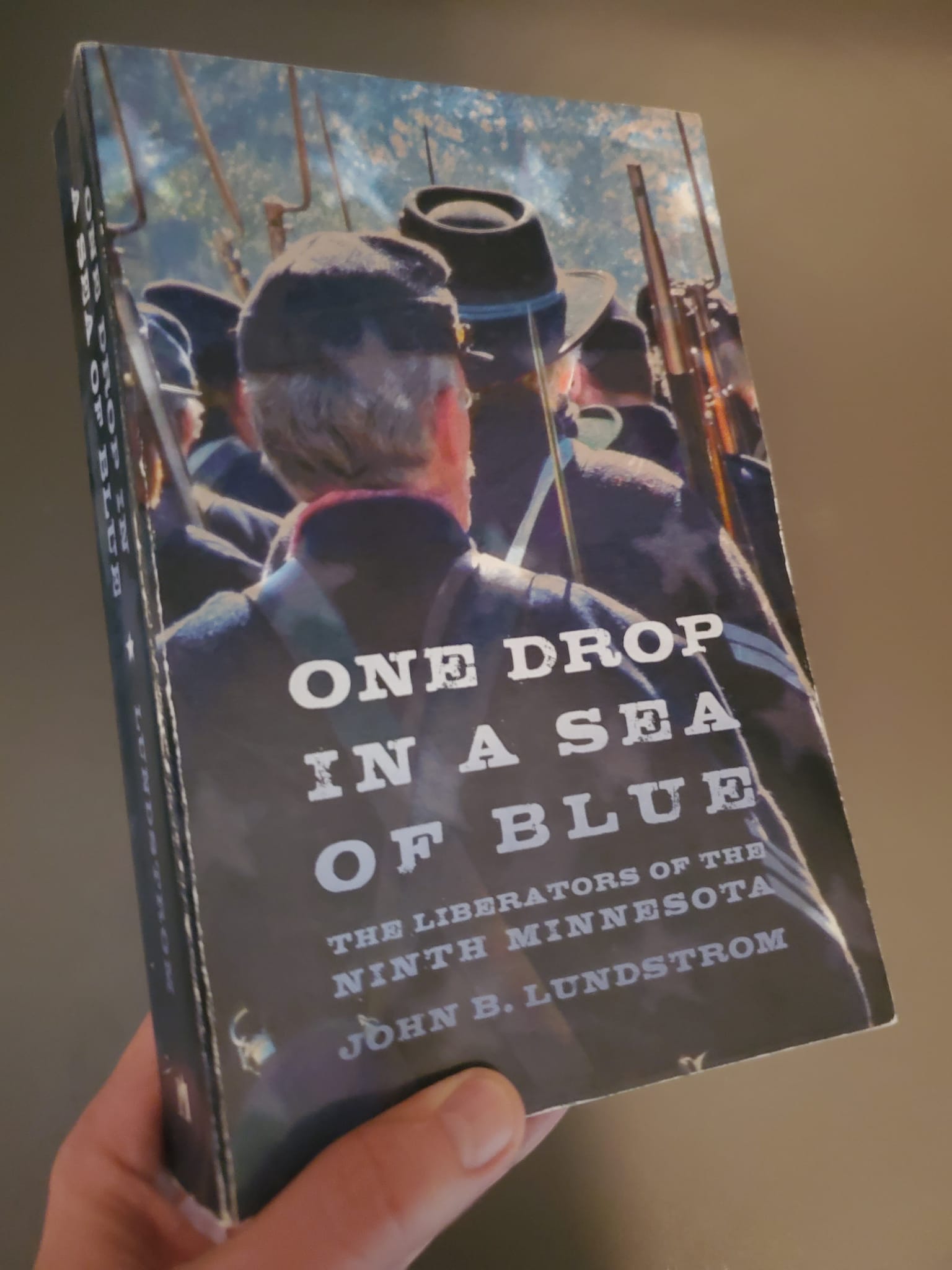


Just finished reading 𝘖𝘯𝘦 𝘋𝘳𝘰𝘱 𝘪𝘯 𝘢 𝘚𝘦𝘢 𝘰𝘧 𝘉𝘭𝘶𝘦 by author John B. Lundstrom, Curator Emeritus of History at the Milwaukee Public Museum. My great-great-granduncle 𝗔𝗻𝗱𝗿𝗲𝘄 𝗦𝘄𝗲𝗻𝘀𝗼𝗻 served in the 𝗡𝗶𝗻𝘁𝗵 𝗠𝗶𝗻𝗻𝗲𝘀𝗼𝘁𝗮 𝗜𝗻𝗳𝗮𝗻𝘁𝗿𝘆 during the Civil War. He fought the Confederates in the Missouri campaign, Battle of Brice’s Crossroads, Battle of Tupelo, the Oxford raid, the Siege of Mobile, and the Battle of Nashville. So I came across this book with true stories of the 𝗡𝗶𝗻𝘁𝗵 𝗠𝗶𝗻𝗻𝗲𝘀𝗼𝘁𝗮. Richly detailed and extensively researched from wartime diaries, letters, military records, eyewitness testimony, and other firsthand sources. Excellent book and well worth the read!
Two companies of the 𝗡𝗶𝗻𝘁𝗵 𝗠𝗶𝗻𝗻𝗲𝘀𝗼𝘁𝗮 were assigned to guard the railroad bridge over the Lamine River near Otterville, Missouri. The Lamine Bridge was among the most vulnerable points on the rail line that supplied a strategic position for the Union Army in west-central Missouri. The soldiers were encamped in the Otterville region when a twenty-eight year old Black man approached the guards at the gates of the camp, pleading for help. His name was John and he had been enslaved on a farm about twenty miles west in neighboring Pettis County, Missouri.
John, his wife Rachel (and their five small children), his teenage sisters, Anna and Patsy, his younger brother Billy, and Billy’s wife Rachel had managed to stay together as a family in spite of slavery. They labored in the fields from sunup to sundown for six days a week on the farm of their enslavers, Charles Willis Carter Walker and his wife Martha Vienna Thomson. Family was all they had. On the evening of Tuesday, November 10, 1863, Walker announced that John and his family were to be sold down the river.
The family would certainly be separated and quite possibly never see each other again. While Walker was preparing to ship his eleven slaves by rail east through St. Louis and then by steamboat to a slave market across the border, John made his escape. He was taking a great risk fraught with danger. Slaves traveling overland without military protection were prone to recapture or violence from pro-Confederate bushwhackers and guerillas. There was a real possibility he could be attacked but he was desperate to prevent the break-up of his family. His plight made him a fugitive on the run.
After John had run away, Walker loaded his human cargo in a wagon. When Billy resisted, Walker shot him six times, three times in the head, killing him instantly. On the morning of November 11, 1863, Walker and his brother drove the wagon a few miles east from his farm to the railhead at Sedalia, the western terminus of the Pacific Railroad in central Missouri. The train for St. Louis was scheduled to leave Sedalia at 8:14AM. In Sedalia, Walker obtained a special permit from Warren B. Davis, the assistant provost marshal, to transport the slaves across the border.
Although the Emancipation Proclamation had been effective since January 1, 1863, it only applied to the eleven states that had seceded from the Union and joined the Confederacy. It did not apply to the loyal border states of Missouri, Kentucky, Maryland, and Delaware. Slaveholders in those states were allowed to keep their slaves (for the time being).
Regardless, the special permit was invalid. The previous day, Special Order No. 307 had been issued from the headquarters for the Union Army’s Department of Missouri in St. Louis. The order stated that “No provost marshal or other officer in military service will permit any person to take slaves from Missouri to any other state.” Union soldiers stationed at Sedalia prohibited Walker from boarding the train with his slaves. So Walker and his brother drove the wagonload of slaves a few more miles east to Smithton, the next stop on the rail line, where there were no Union soldiers. He smuggled the slaves aboard a boxcar there. The next stop was Otterville.
John had been on the run all night. When he entered the camp of the 𝗡𝗶𝗻𝘁𝗵 𝗠𝗶𝗻𝗻𝗲𝘀𝗼𝘁𝗮 near Otterville shortly after sunrise that morning, he was physically exhausted and emotionally distraught. The soldiers listened to his plea and were “moved by his story.” The 𝗡𝗶𝗻𝘁𝗵 𝗠𝗶𝗻𝗻𝗲𝘀𝗼𝘁𝗮 already strongly opposed slavery. Furthermore, John represented himself as a loving and loyal husband, father, and brother. His strength of character, fortitude, and courage made a strong impression on the Minnesotans. A sergeant immediately stepped up and asked for volunteers from Company C to assist in rescuing the slaves while a corporal mustered volunteers from Company K. In all, thirty-eight soldiers agreed to help John.
There was only one slight problem. It was government policy not to intervene in such matters in the loyal state of Missouri. Union soldiers were under orders to neither help nor hinder fugitive slaves. However, the commanding officer, Captain David W. Wellman, was absent at the time which prompted the men to act of their own volition. Time was of the essence so they grabbed their Springfield rifles, crossed the Lamine Bridge, and marched west on the Otterville road. When they reached the railroad depot, the soldiers lined up along the Otterville station platform and waited a few minutes for the train to arrive. The train pulled into the station at 8:55AM.
The Minnesotans began sliding open the doors of the freight cars in search of the nine slaves who were eventually found huddled inside a cold, dark boxcar. Emily and Rachel were tied together. The sergeant and eight other soldiers stepped on board the car and had begun untying them when the conductor angrily demanded to know what right the Minnesotans had to take slaves from his train. “Where are your officers?!?” he said. “We are all officers,” one Minnesotan quipped.
The commotion drew the attention of passengers. Among the passengers riding on the train were two members of the Missouri State Militia, both of whom were captains. Captain Levi Pritchard, the Inspector of the District of Central Missouri, and Captain Oscar B. Queen of the Seventh Missouri Militia Cavalry stepped off the train and confronted the Minnesotans but the soldiers refused to recognize the authority of the militiamen. When Queen told them he was the Commanding Officer of the District, some of the Minnesotans said, they “didn’t give a damn.”
While this was happening, the conductor sprinted up the platform shouting to the engineer of the locomotive to get the train moving. After the engineer rang the bell to signal the train was leaving the station, some of the soldiers blocked the train from departing before John’s family could get off. Then cocked their guns on the conductor and engineer and threatened to riddle the boiler of the steam engine with bullet holes if the train didn’t stop in its tracks. Pritchard heard Queen tell the Minnesotans “they had no orders” to free the slaves but “they refused to obey him and took the slaves off the train” anyway.
John embraced his family “joyfully” in his arms on the station platform. Queen was furious and even threatened to have the soldiers court-martialed. As the train had already departed, the Minnesotans started back toward camp, bringing John and his family with them. Afterwards, the train stopped at the Lamine Bridge where both Queen and Pritchard stomped into the encampment demanding to see the commanding officer. Captain Wellman denied his men acted upon orders from him. Queen, Pritchard, and Wellman quickly boarded the passenger car, and the conductor set the train in reverse.
The slaves and soldiers had only walked a short distance before they saw the train coming back toward them. John and his family were compelled to hurry into the woods and hide in the brush. When the train stopped next to the Minnesotans, John and his family had already disappeared into the timber. Wellman demanded to know where the fugitives were but his men lied and said they left them behind at the depot. So the train continued on to Otterville station.
The Minnesotans arrived back at the Lamine camp. An hour later, two soldiers slipped away and returned to where John’s family was hiding. They led the runaways to a place in the forest where they would be safe until nightfall. From his headquarters at Tipton, Queen telegraphed General Egbert Benson Brown, commander of the U.S. volunteers in central Missouri, with a complaint about the “high-handed outrage” committed that morning by thirty-eight men of the 𝗡𝗶𝗻𝘁𝗵 𝗠𝗶𝗻𝗻𝗲𝘀𝗼𝘁𝗮 𝗜𝗻𝗳𝗮𝗻𝘁𝗿𝘆. General Brown insisted that the Missouri militia officers held authority over the Minnesota troops.
That evening, two Minnesotans snuck out of camp again to deliver the family a loaf of bread and some pork. Then helped hide John and his family in a swamp. Later some slave catchers had gone out to catch the fugitives and hunted all night but never found them. The next morning, the two companies were lined up in camp where Captain Wellman ordered all involved in the incident to step three paces forward. All thirty-eight Minnesotans stepped forward without hesitation. Then Wellman presented Brown’s order to produce the escaped slaves or suffer arrest. After refusing to reveal the slave’s hiding place, the men were taken into custody on “trumped-up” charges and sent to Jefferson City under guard.
On November 13, the 𝘓𝘪𝘣𝘦𝘳𝘢𝘵𝘰𝘳𝘴, as they were nicknamed by the press, were detained at Jefferson City while awaiting the filing of formal charges for trial. They were locked up for violating Sections 6, 7, 8, and 9 in the Articles of War and faced court-martial for serious offenses including contempt toward a commanding officer, insubordination, illegally harboring runaway slaves, and mutiny, a crime punishable by death.
The enslaver had friends in high places. His father, James Thomas Walker, was a member of the U.S. House of Representatives. One of his uncles, David Walker, was a congressman. Two of his uncles were U.S. Senators: his uncle, Freeman Walker was a U.S. Senator from Georgia and his uncle, John Williams Walker, was a U.S. Senator from Alabama.
On January 17, 1864, responding to an inquiry from the United States Senate, the Federal commander in Missouri, John M. Schofield, submitted the documents in the case to Secretary of War Edwin Stanton. General Brown requested to convene a board of inquiry but was rejected. In a stroke of irony, Brown was later relieved of his command and arrested for disobeying orders during a battle. On February 1, William Starke Rosecrans assumed command in Missouri and recommended the charges be dropped. On February 27, Stanton submitted the papers to the Senate and the case was finally dismissed.
Weeks earlier, the headquarters of the District of Central Missouri quietly issued Special Order No. 7. The imprisoned men of Companies C and K of the Ninth Minnesota Infantry were released and returned to duty. Ultimately, the 𝘓𝘪𝘣𝘦𝘳𝘢𝘵𝘰𝘳𝘴 were never court martialed nor tried in any way, never even reprimanded. The “Otterville Incident,” as it has since become known, was an unprecedented event of the Civil War that has been largely forgotten with time. As for the murder of Billy, Charles Willis Carter Walker was never brought to justice.
