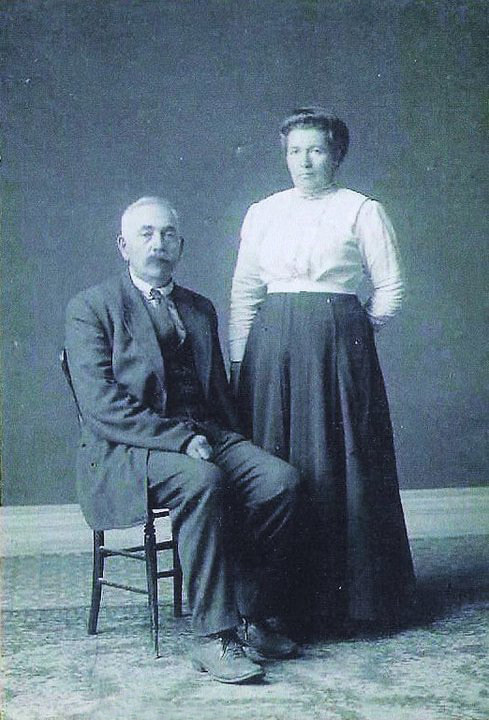


The first image is a portrait of my great-great-grandparents from my paternal grandmother’s side: 𝗠𝗮𝗿𝗶𝗼𝗻 𝗖𝗿𝗶𝗱𝗲𝗿 and 𝗡𝗮𝗼𝗺𝗶 “𝗢𝗺𝗮” 𝗠𝗮𝘆𝗻𝗮𝗿𝗱. Both were originally from Eastern Kentucky. Marion was born on June 30, 1856 while Oma was born on November 8, 1863. She belonged to the 𝗠𝗮𝘆𝗻𝗮𝗿𝗱 𝗙𝗮𝗺𝗶𝗹𝘆 of Appalachia. After the Civil War, her family migrated to Meeker County, Minnesota when she was just two years old.
In May of 1866, Oma and her family traveled 1000 miles overland by covered wagon to Swan Lake, Minnesota when it was newly opened wilderness. They were the first settlers of Dassel and lived as “woods” farmers who also raised livestock. By 1867, most of Minnesota was being opened for settlement and, before long, other Kentuckians were also settling in Dassel. Marion came to Dassel as a young man in about 1877. He was 21 years old while Oma was 14 years old when they were married on February 13, 1878. Oma’s father, Reverend William Maynard, officiated their wedding and her brother George Maynard and his wife Margaret served as witnesses.
Marion and Oma lived in Dassel for a little over a year until they went to seek a homestead. Marion filed a homestead claim on the south half of southwest quarter and northeast quarter of the southwest quarter of section 6, township 131, range 34. They traveled the old Indian trail by ox team through Swanville to central Todd county which, at the time, was untamed wilderness. It took five days to travel the 100 miles from Dassel to Clarissa. Clarissa was then a place of only a few log cabins.
They started out into the wilderness inhabited only by Indians and had to cut eight miles of road through forest from Clarissa to complete the journey. Once they arrived at their homestead, they built a log cabin on the hillside. The cabin was completed in the fall of 1879 and they moved into it and then began to clear some of the land. There were a number of Indians in the area during the first winter.
Marion and Oma were true pioneers who established their farm near the bend of Eagle Creek. Life on the frontier was especially difficult. There were no towns nearby so they had to go all the way to Long Prairie to get their supplies. Marion walked the almost 20 miles from Long Prairie to Eagle Bend carrying a 100lb bag of flour on his back and it took him 2 or 3 days.
The hardships they endured are unimaginable in today’s world of modern conveniences. Their nearest post office was in a little hamlet near Browerville called “Old Hartford” but which has long since been abandoned. Sometimes it was necessary to swim across the river in order to get their mail and provisions. When provisions were scarce, wild game was hunted to feed the family.
Eagle Valley township was eventually organized. The second image is a map with the Crider homestead highlighted in red. Marion established the first schoolhouse known as the “Crider School” and served as a trustee in the district for many years. In 1882, Benjamin Abbot settled the area and built a log building that he used as a general store and dwelling for his family. His first customer was Marion Crider who bought a pound of Arbuckle’s Roasted Coffee according to a newspaper clipping from The Eagle Bend News. The third image is a copy of the article published on July 21, 1949.
All of their children except for their oldest child Jane were born on the homestead. The fourth image is a photograph of the Crider home, located west of where the log cabin was built. Pictured in front of the home (from left to right) are Virgil, Jane, Alma, John, Hattie, Oma, William, Marion, 𝗦𝗼𝗽𝗵𝗶𝗮, and Vernon in the baby stroller. The railroad to the townsite was completed in the summer of 1883 and benefitted the community. The village of Eagle Bend was incorporated on January 21, 1890.
After 50 years of marriage, Marion and Oma celebrated their golden wedding anniversary on February 13, 1928 at their home with a large gathering of friends and family where guests enjoyed a big dinner and stories told about the early days. A newspaper article about the event is available on microfilm from the Minnesota Historical Society in St. Paul.
On his trip to Minnesota last weekend, my Dad said he drove past the old homestead and the house is still standing. Dad has some of the antique chairs from the homestead that he acquired from Vernon’s auction years ago. He stopped by to visit with a first-cousin while he was there who also has some of the Crider heirlooms. He said he enjoyed seeing the old Crider spinning wheel. Oma used the old spinning wheel to sew clothing and other things. She taught my great-grandmother 𝗦𝗼𝗽𝗵𝗶𝗮 who made all my Dad’s shirts and pants for grade school and stitched his name in them.
Marion and Oma lived the rest of their lives at the old homestead. In an article published in 1937, Otis Bernard Delaurier writes, “No more worthy pioneer ever came to make his home in any community than Marion Crider, who struck into the wilderness northeast of Eagle Bend in 1878 … land he then selected has been his home ever since. It is a matter of pride to him … that no one has ever held a mortgage against his land or property since he came to Todd county.” Marion lived to be 89 years old and was buried at the G.A.R. cemetery in Eagle Bend after he died on January 30, 1946. Oma preceded him in death on April 19, 1937 and is buried next to him.
